Using Squiggler in advanced simulation technology
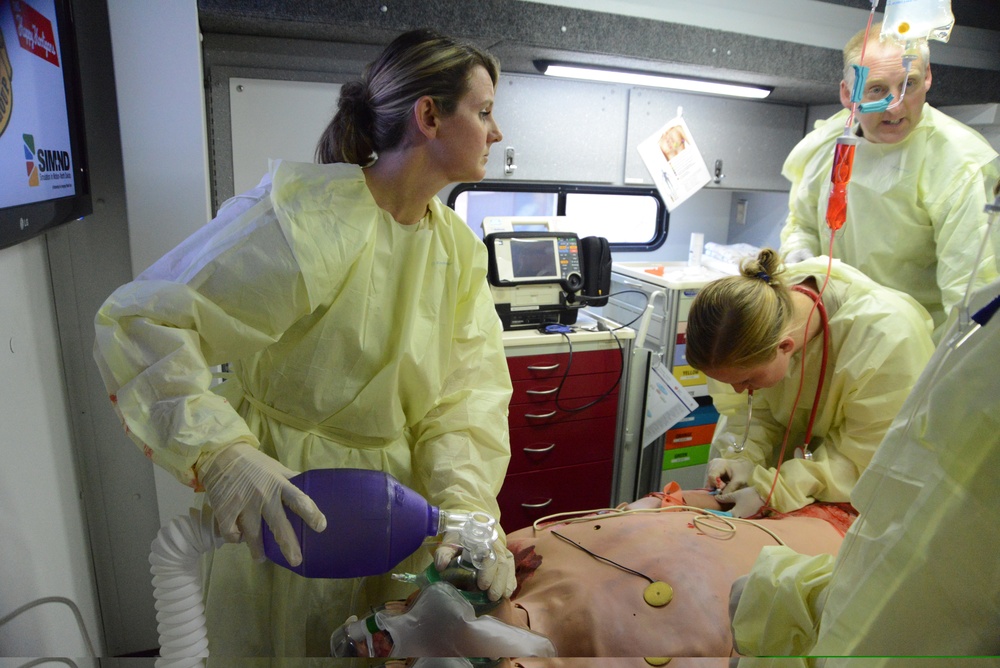
In a good simulation everything should feel as real as possible: the drugs drawn up, the monitor, clothing. Even if the patient is a manikin, an immersive experience is possible with the correct setup.
Where the ECG falls behind
The scenario, the vitals, the drugs and the debrief can now be written for each team, and increasingly, large language models are involved in drafting them from a list of learning objectives. The ECG usually cannot be written to order. A monitor plays rhythms from a fixed library, and the twelve-lead handed over mid-scenario is a scan from a textbook or an anonymised recording that in best case almost fits. When the case says a heart rate of 38 and the paper shows 60, learners notice, and asks you the question that breaks the realism:
"What does the ECG show?"
What Squiggler can make possible
- Written to order. The case is presented and the ECG can be adapted to it.
- One patient across stages. Arrival, deterioration, arrest: the ECG shows the same appearance of the complexes, the same small details that makes us unconsciously think that it is the same patients ECG and not stock image.
- One truth on every screen. The monitor waveform, the printed twelve-lead and the vitals agree.
- Checkable by a machine. If AI is involved in case drafting, image models cannot be verified to correctly show that the findings are consistent with the case. Squiggler's API returns the actual parameters that can be double checked.
Three stages, one patient
A 71-year-old who has missed dialysis arrives weak and nauseated. Heart rate 53.

Twenty minutes later, before the calcium is in, the heart rate is 38. The examined student ask for a ECG and one can be shown immediately, with matching heart rate and findings which include widening of the QRS and complete heart block.

Then the bedside monitor. The P waves have gone, a nodal rhythm at 32 carries the last few beats, and then it stops.

Every stage keeps the same patient seed, and every rate on the paper is the rate in the vitals.
Where it fits
In a case generation pipeline Squiggler is one step: the model writes the patient and the stages, Squiggler draws and measures the heart at each stage, and any stage whose vitals disagree with the tracing is regenerated before faculty review. The case generation overview shows the whole loop.
Picture credits
- Simulated resuscitation, North Dakota Air National Guard Base, 2014: U.S. Air National Guard photo by Senior Master Sgt. David H. Lipp, via DVIDS, image 1586030, public domain. The appearance of U.S. Department of War (DoW) visual information does not imply or constitute DoW endorsement.
- Tracings: Squiggler.