NAP: a patient monitor in every browser
NAP turns any browser into a patient monitor you control from your phone, free during its beta. Its 12-lead generator now hands patterns over to Squiggler for fine-tuning.
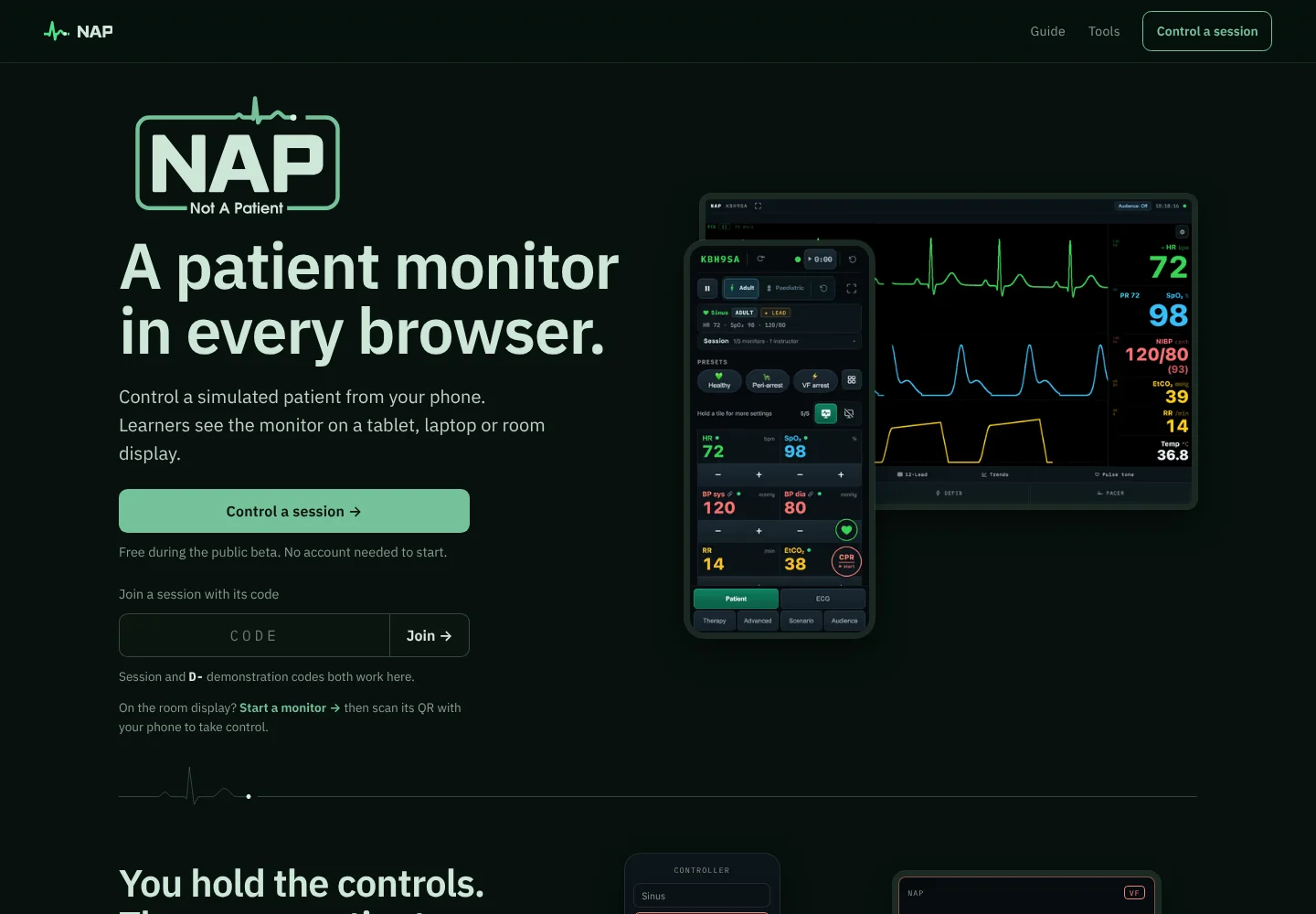
Most simulation rooms still have the same weak spot: the monitor. A manikin can breathe and talk, but the screen behind it is often a laptop running a slideshow, or a monitor simulator that costs as much as the manikin. NAP, short for Not A Patient, takes a different route. It turns any browser into a patient monitor, and your phone into the remote control.
A monitor on any screen, controlled from your phone
You open a session on your phone and share its code. Every tablet, laptop or room display that joins becomes the learner's monitor, and up to 100 people can follow along. When you change the rhythm or a vital sign on your phone, every connected monitor updates.
It is free to try during the public beta.
More than a passive screen
A few things we liked:
- Physiology that hangs together. Heart rate is counted from the ECG and pulse rate from the pleth, so in ventricular bigeminy the pulse rate falls to about half the ECG rate. Compressions obscure the ECG, and EtCO₂ follows the quality of the CPR you set.
- Questions for the room. Ask a multiple-choice question and watch the answers arrive on learners' phones.
- Adults and children, with four paediatric age bands, plus advanced monitoring in beta for anaesthesia and intensive care teaching: invasive pressures and processed EEG.
A free 12-lead generator, and a bridge to Squiggler
Alongside the monitor, NAP has two free tools that need no session: a quick 12-lead ECG generator, and a blood gas generator for ABG and VBG slips.
The 12-lead generator works from fixed presets, which makes it quick to print a handout. When you want more control than a preset gives you, it now offers a link straight into Squiggler:
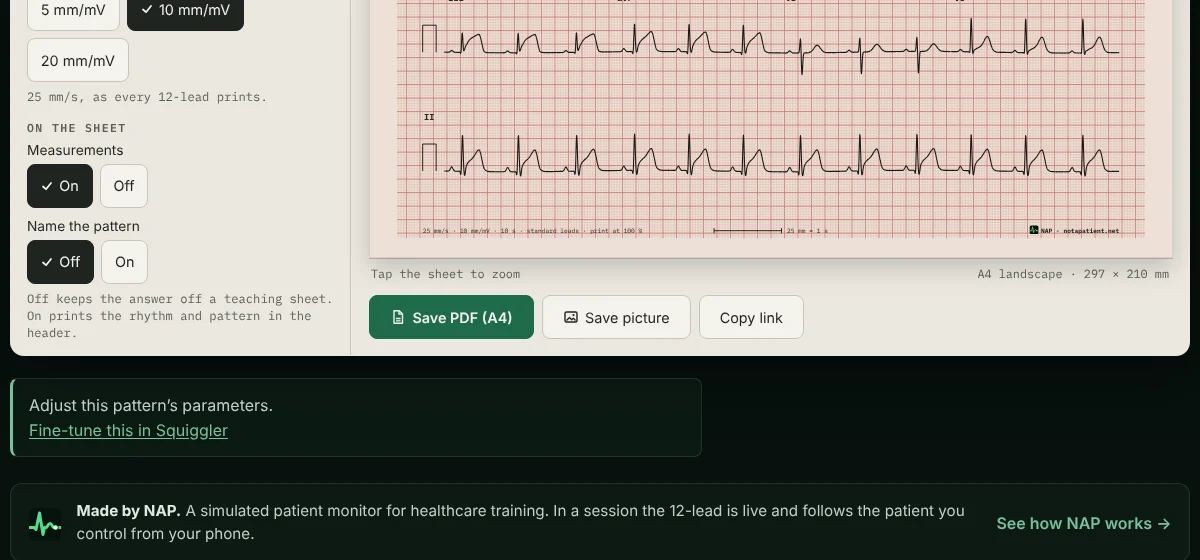
The link opens the same pattern in the Squiggler studio, where you can change the rate, the territory and size of the ST elevation, the intervals and the recording conditions, or draw the same finding in a different patient. Here is NAP's inferior STEMI preset as it opens in Squiggler:

We think the two fit together well. NAP is the live monitor in the room, where the patient changes in front of the learners. Squiggler is where you prepare the tracings for the case, the handout and the debrief.
Try it
- Start a session at notapatient.net: open it on your phone, then on the screen your learners will watch.
- Make a 12-lead in the ECG generator, and fine-tune it in Squiggler.
NAP is built by Laszlo Zavori and is for simulation training only. It is not a medical device or a patient-monitoring system, and neither is Squiggler.